Bald Cypress: Bud Pinching vs. Defoliation
This is a topic on which I did not elaborate in the manual I wrote, Bald Cypress as Bonsai: Course Manual. I think now is a good time to talk about it, since I defoliated a large cypress a few weeks ago. I think it important to talk about the purpose of defoliation as well as the purpose of bud pinching as they relate to bald cypress. It is not my intent to provide an in-depth article on defoliation and/or bud pinching. I will simply provide some basic guidelines and practices so that you have a clear understanding of the process. My reason for writing this is to help those who grow bald cypress as bonsai to understand when each technique is appropriate to use.
Let’s talk first, in a general way, about defoliation or leaf-stripping. I want to talk about several aspects of this process: on what trees we use with this technique, on what trees we do not, why we do it, when we do it and when we do not do it.
So let’s start from the beginning. Leaf defoliation can be carried out on most deciduous trees and some of the broadleaf evergreens. It consists of the total or partial removal of leaves from the tree. Defoliation should only be carried out on young, healthy, vigorous-growing trees. It should not be conducted on trees that are in a weakened state of health or on trees that are inherently weak by their genetic nature, such as red-leaf Japanese maples.
Why defoliate a tree? There are several reasons. First and foremost, we do it to reduce leaf size. This is the primary reason for doing it. Second, it is a way of renewing the leaves. It allows you to remove leaves that may be damaged by wind or dryness and produce a new crop of leaves that are more uniform in color. It can also help to produce better fall color, if done at the correct time. Another valid reason is to prevent transplant shock of a deciduous tree if you are repotting it during the active growing season.
Many people are under the impression that defoliation is the technique we use to get better ramification of the branches. If that is your focus, then you are using the wrong technique. You may have some success at attaining better ramification if the defoliation is carried out early in the season, just after new foliage has hardened off, but even then, your success will be limited. If you defoliate early in the growing season, like April or May, you should only remove about half the foliage. Then remove the other half about 10 days later. The reason for this is that the sap is still rising in the tree and pushing out new growth. Removing all the leaves at once creates pressure in the vascular tissues that can damage the tree. By defoliating a tree early in the growth season, there is still enough energy left to not only push out a second set of leaves, but also to cause some of the dormant buds to pop. However, this will only result in a relatively small number of new shoots developing. And if your timing is off, given the species of the tree, you will get no new shoots to develop.
Remember, the main reason to defoliate is to attain reduction in the leaf size. And it should only be done on very healthy trees. You are, in effect, forcing the growth of next years’ leaves. Therefore, if you carry out this process on an old tree or one that is weak or in poor health, it may fail to sprout and eventually die. Or, at best, only portion of the tree will survive.
The best time to defoliate is from June to the first of August. Do it any earlier, when the flow of sap is high and the leaves will not reduce in size. In fact, they may come out larger than the original leaves. Do it any later in the season and the tree may only sprout new leaves on some of the buds and at worst, may fail to sprout at all. Think of it like this: let’s say that a tree has 100 units of energy stored up over the winter. During a regular active growing season, the tree normally expends 60 units of energy to push out all the new growth for that year. By April, it has used 40 units of the 60 units of energy to push out new growth. But the sap is still rising and the tree is still wanting to push out new growth and use the other 20 units it has set aside for new growth. You remove half the leaves on April 1st and on April 10th you remove the other half. During the rest of the active growing season, the tree uses another 30 units of energy to replace all the leaves that were removed and an additional 10 units of energy to produce new shoots from dormant buds. The tree used a total of 80 units of energy
and held back 20 units in case of disaster. The rest of the active growth season will be spent replacing the energy units that were consumed via photosynthesis. However, you run the risk of little leaf size reduction and may only get a few dormant buds to sprout. The thing to remember is that the tree will not be able to produce enough food to equal what it had before defoliation and you will start off next growing season with a tree that is weaker than it was the year before. This is why it is not advisable to defoliate every year.
Total units of energy 100
Energy used before defoliation 40
Energy used to replace foliage 40
Total units of energy depleted from tree 80
Now let’s say that the same tree, with its 100 units of energy, has used 60 units by the first week of June to push out all the spring foliage, but by late July, the sap is no longer rising and the tree has had a chance to replace, through photosynthesis, 20 units of the 60 units used to push out this years’ growth. So now, the tree has effectively only used 40 units of energy when you
defoliate. The tree uses another 40 units of energy to push out next years’ set of leaves. It pushes out the same number of leaves but with a lowered volume of energy, so the leaves are smaller. A tree will never use all of its energy to replace leaves. They are always in survival mode and they hold back a certain amount of energy in case of disaster, so that at least some portion of the tree can survive.
While there is some back-budding after defoliating bald cypress, 9 times out of ten it occurs in the crotch of a branch. Now unless one of the shoots emanating from the crotch is dead, the new shoot is useless and will need to be removed. The exception to this is when you want to use such a shoot to create another layer of foliage on top of a branch. However, in my experience, you will wind up removing about 80-90% of such shoots.
I hope my analogy made at least some sense. So now, let’s talk about bud pinching. Bud pinching has but one main purpose – increased ramification. A secondary purpose is to redirect growth to other parts of the tree. However, bud pinching on trees in the ‘Growth for Design Stage’ is only carried out on shoots that have already elongated and are competing with parts of the tree essential in the design.
Let’s take the same tree talked about above. Over the winter, it has stored 100 units of energy for growth in the spring. The sap is rising and all the buds are opening and elongating. When you pinch the terminal tips of the buds, you are negating the auxins, or growth hormones, at those tips. Auxins are like suction cups, pulling energy to the tips for growth. When you pinch out the growth tips, auxins are diverted to other areas of the tree, including dormant buds. The effect is shorter internodes and back-budding. So our tree with the 100 units has only used 10 units of energy to activate buds for spring growth. The sap is rising strongly and when the message is sent that growth can no longer be elongated at the sites currently being used because you have pinched out the tips, the tree diverts the energy to other parts of the tree, including dormant buds. The tree is determined to use the requisite amount of energy needed to complete the current years’ growth. The main result is increased branching and ramification.
But you must remember… bud pinching for ramification should only be done on trees that are in the ‘Refinement Stage of Development’, not during the ‘Growth for Design Stage’ and certainly not for the ‘Growth for Size Stage.’ The only time you pinch terminal buds in the ‘Growth for Design Stage’ is to redirect energy to other parts of the tree and only on shoots that have already elongated and are in competition against other needed design elements.
Now let’s talk about the bald cypress pictured below. It has never been defoliated. Only after the primary, secondary and tertiary branching was developed, was bud pinching begun. Bud pinching has only been carried out for the past two years. I know bonsai artists who tell me they defoliate their bald cypress every year. I do not understand why they do that, but I will never be
so rude as to ask. If they ask my opinion, I will give them an answer, but I don’t tell other people what to do unless they genuinely want to know. Defoliating any tree every year is never a good idea, as it continually weakens the tree over time. And if their goal is to increase ramification, they are using the wrong technique. Bud pinching, on the other had does not weaken a tree that has completed the ‘Growth for Design Stage’.
Even with relentless bud-pinching on a bald cypress, you will still have some leaves that will elongate over the course of the active growing season. You can go through the tree and remove oversized leaves, or you can defoliate it. Personally, I am less concerned about oversized leaves and more concerned about getting the ramification I desire through bud pinching and keeping the tree strong. The only reason I defoliated the cypress pictured below was that I was planning on exhibiting it in the fall and wanted to have foliage that was uniform in color and of a consistently reduced size. In the spring, I carried out relentless bud pinching and then I let the tree grow at will. As you can see, it is rather bushy, but very healthy. As it appears in the photo below, the tree is 49 inches tall and 34 inches across at the widest point.
Some bonsai artists make the mistake of trying to ensure that their tree looks ‘show ready’ all the time and are constantly pinching or pruning new growth. What a mistake! You must let a tree grow and get “out of bounds” to retain its health and vigor.
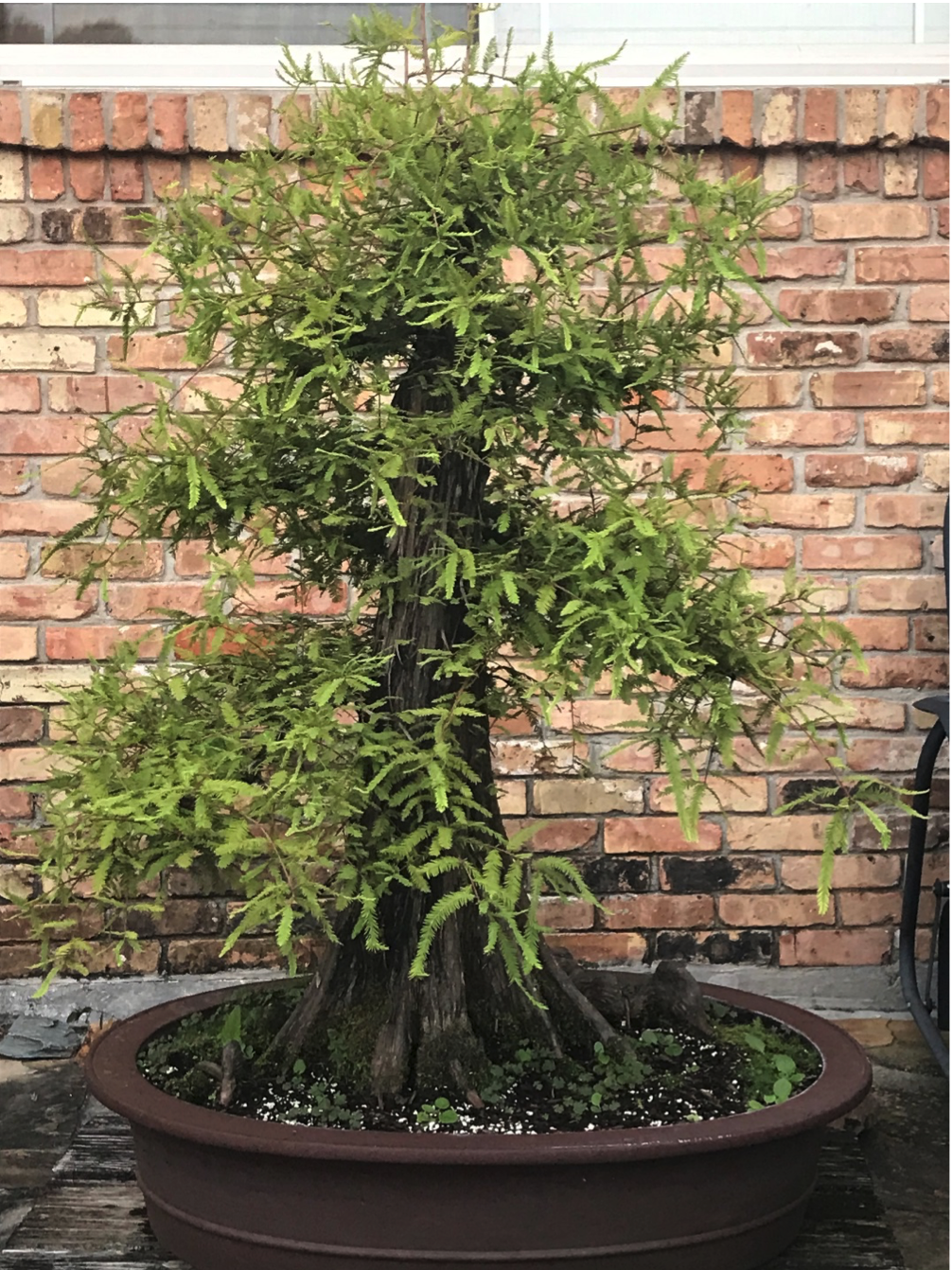
June 15th, 2020
I will first defoliate the tree completely. Second, I will prune unnecessary shoots and wire this years’ growth into position. The tree will get morning sun. On most other deciduous trees, you would water sparingly after defoliating. I will not change my watering habits with my bald cypress. The soil will be kept wet throughout the rest of the growing season.
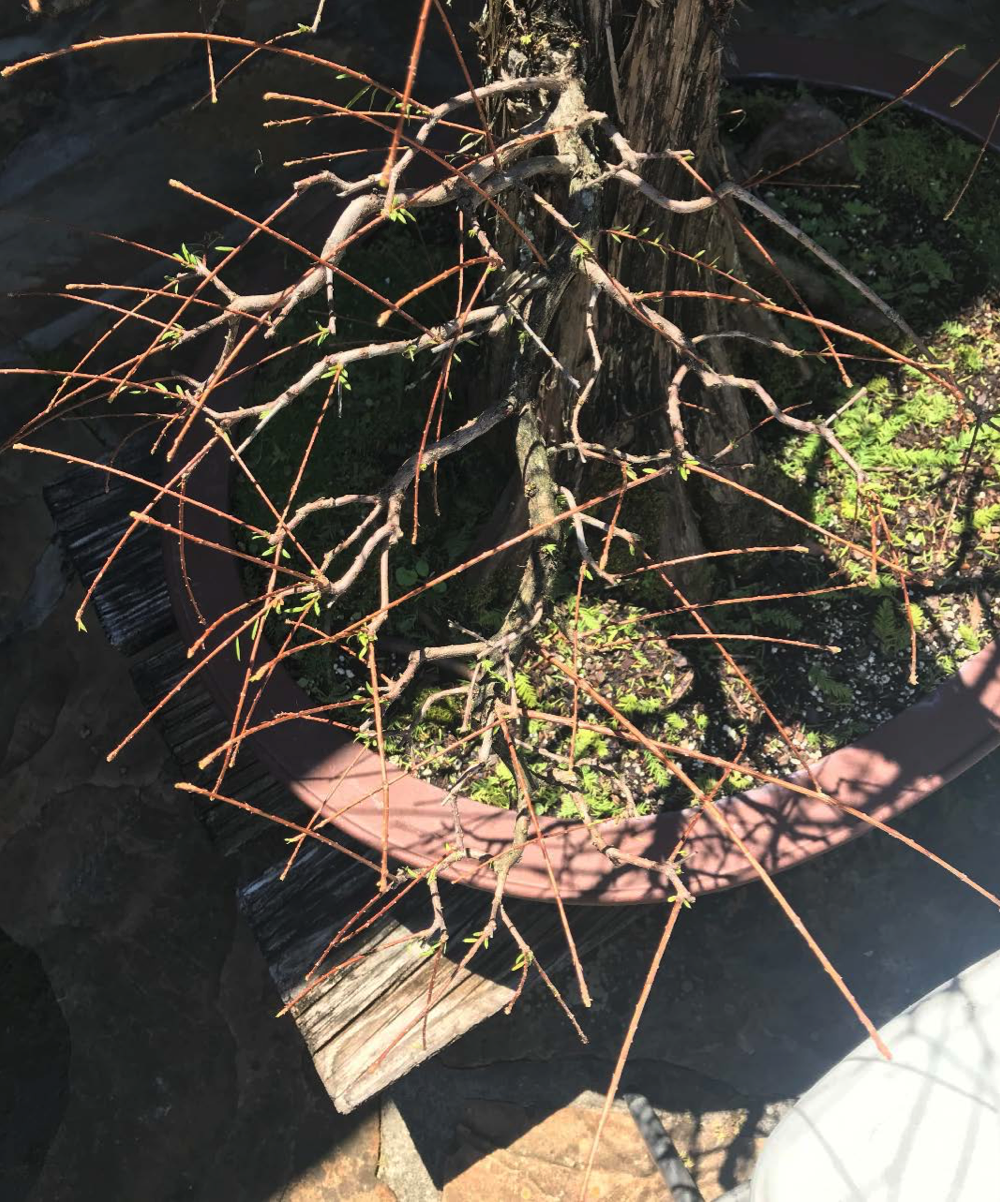
The photo below shows the tree after defoliation. Now will begin the process of removing unwanted branches and shoots and trimming back shoots that will be kept. Shoots that are growing on the bottom of primary, secondary and tertiary branches will be removed. Where more than two shoots emanate from the same point, the more vigorous shoot will be kept and the weaker one(s) removed. In some cases, I have older shoots whose growth has slowed dramatically, but where a new and vigorous shoot has emerged at its base. In such cases I will remove the old branch that is no longer producing and wire the new vigorous shoot in its place. Shoots that have grown too thick in specific areas will be shortened greatly.
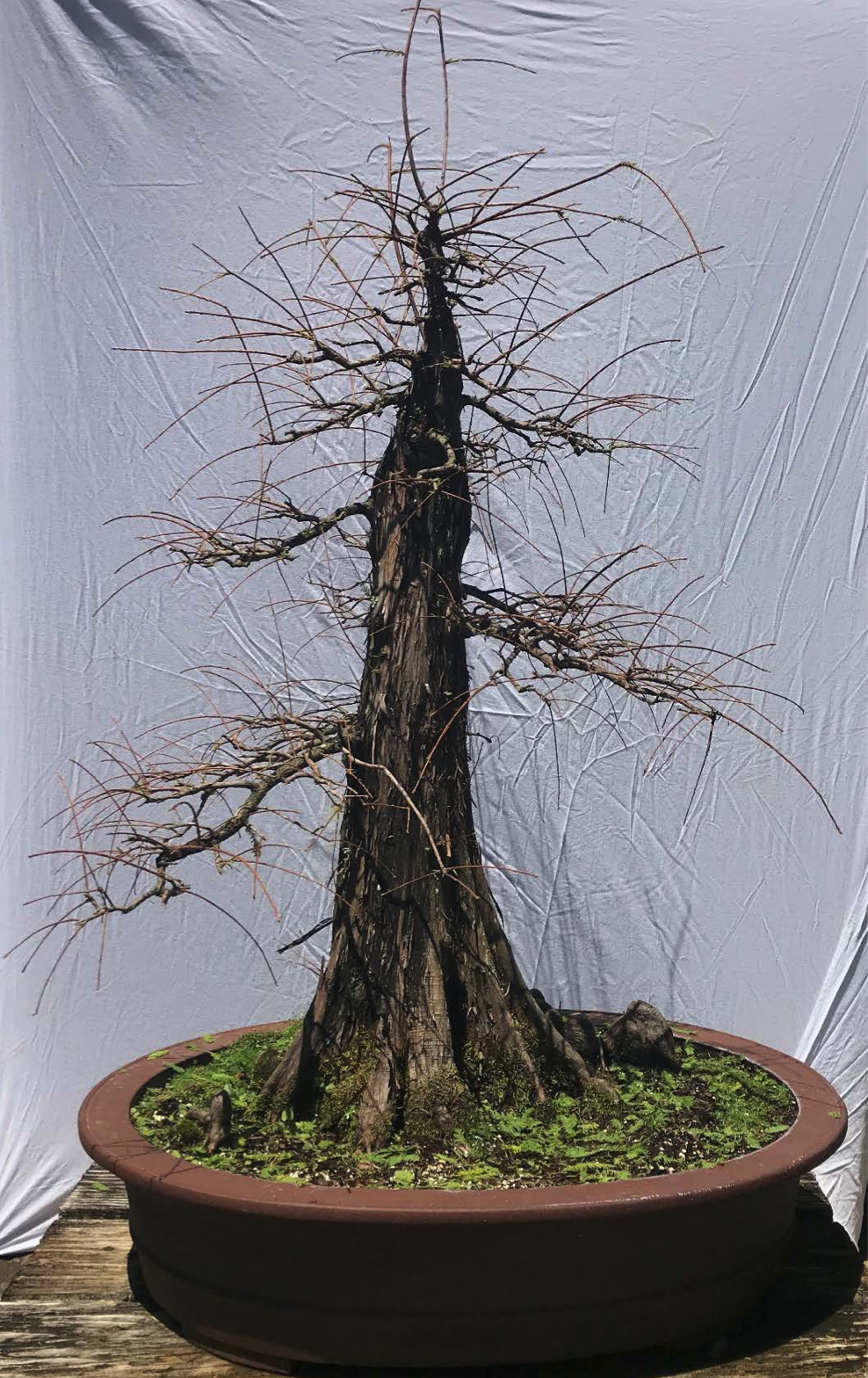
The photo below shows the tree after trimming was completed, but before wiring. The photo shows the tree after pruning away unwanted branches and shortening branches that will be kept. Some of the shoots have been left a little long prior to wiring. Branches will receive movement with the wiring process and this will require a little extra length. So it is best to leave shoots a little long until the wiring is complete. If they need to be pruned after wire is applied, it will be a simple process. Wiring can now begin.
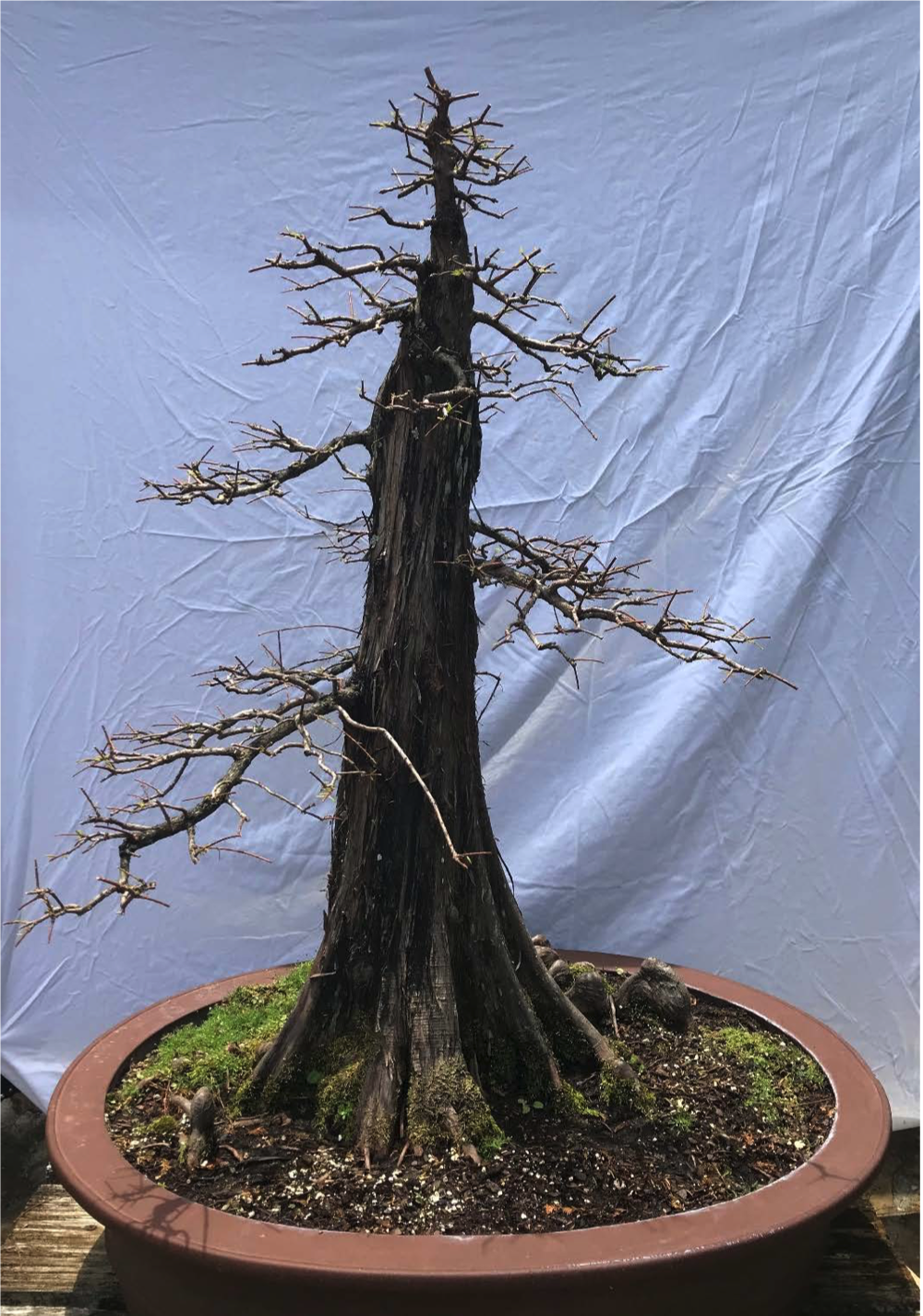
The photo below shows the first primary branch before and after pruning this years’ growth. The next photo shows the first primary branch after wiring. Some of the branches are still being developed and need to thicken in relation to their position as you move from trunk to branch tip. Others are now being restrained.
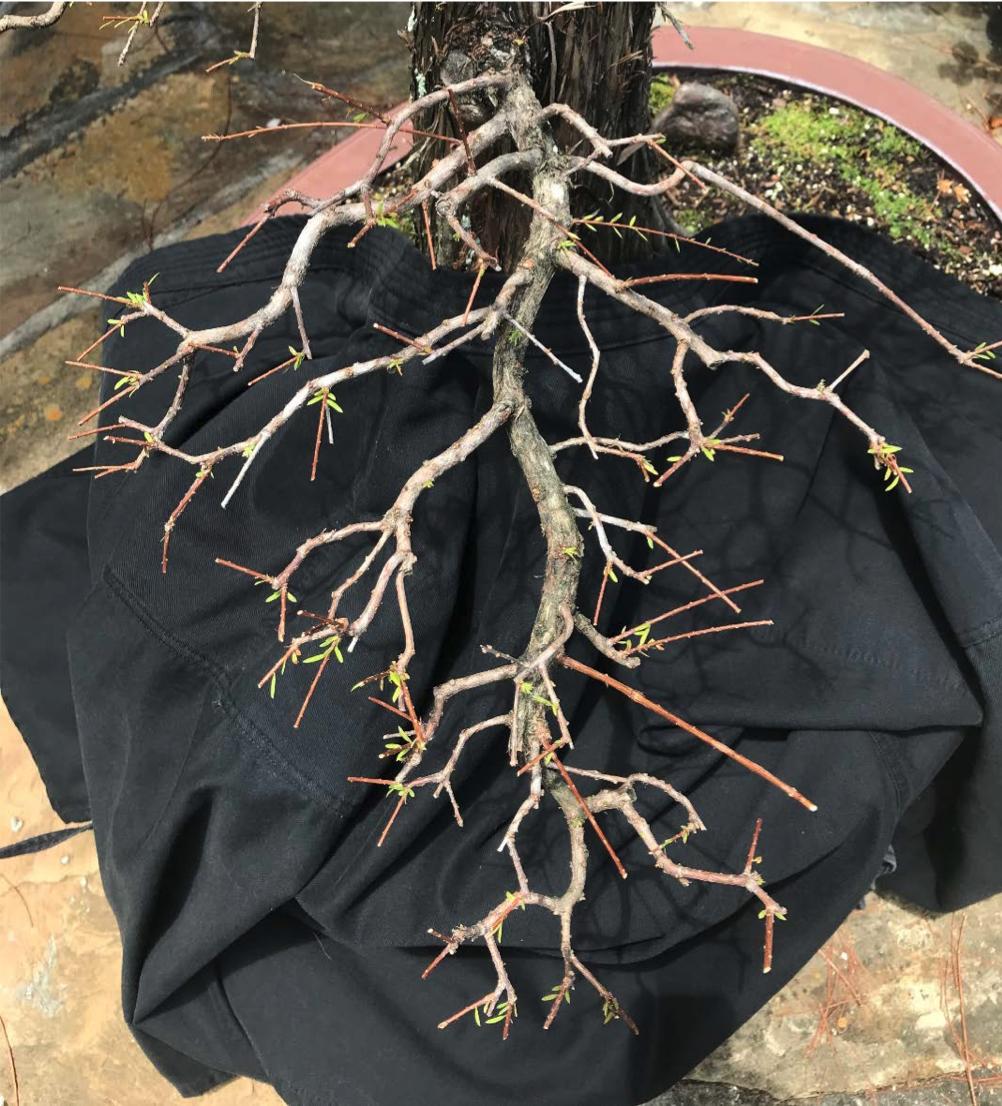
The next series of photos show the entire tree after wiring has been completed.
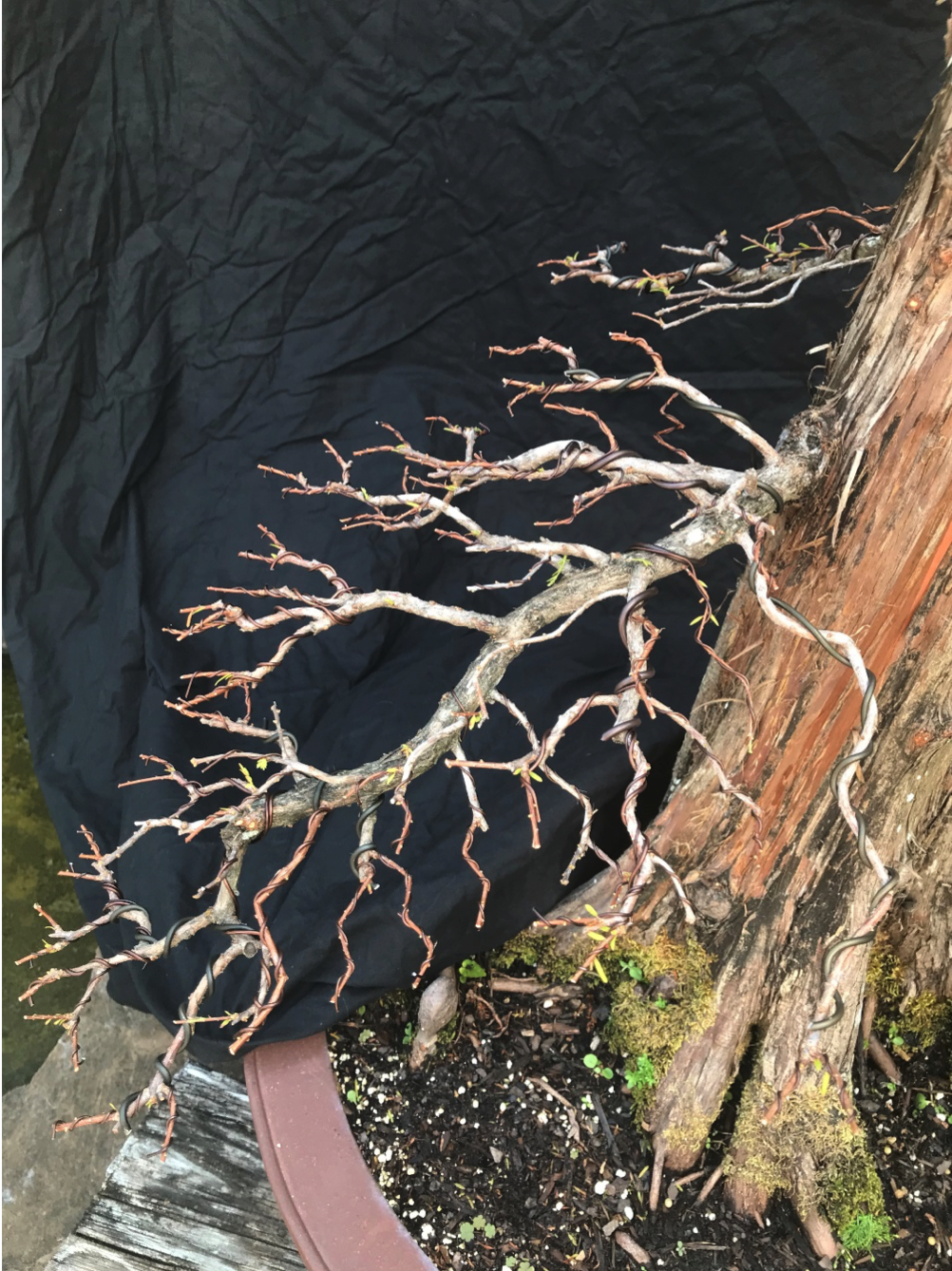
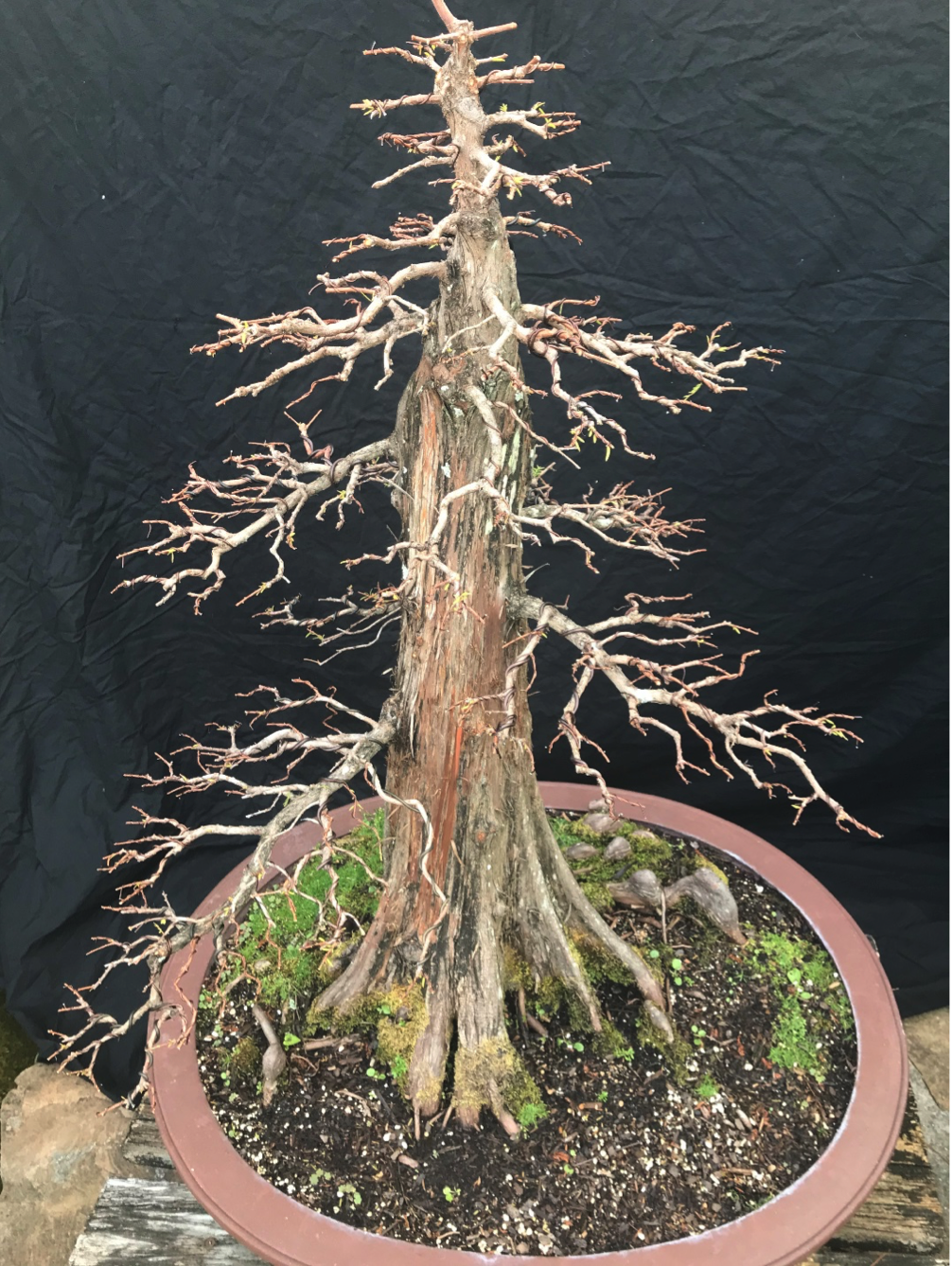
Front side of the tree
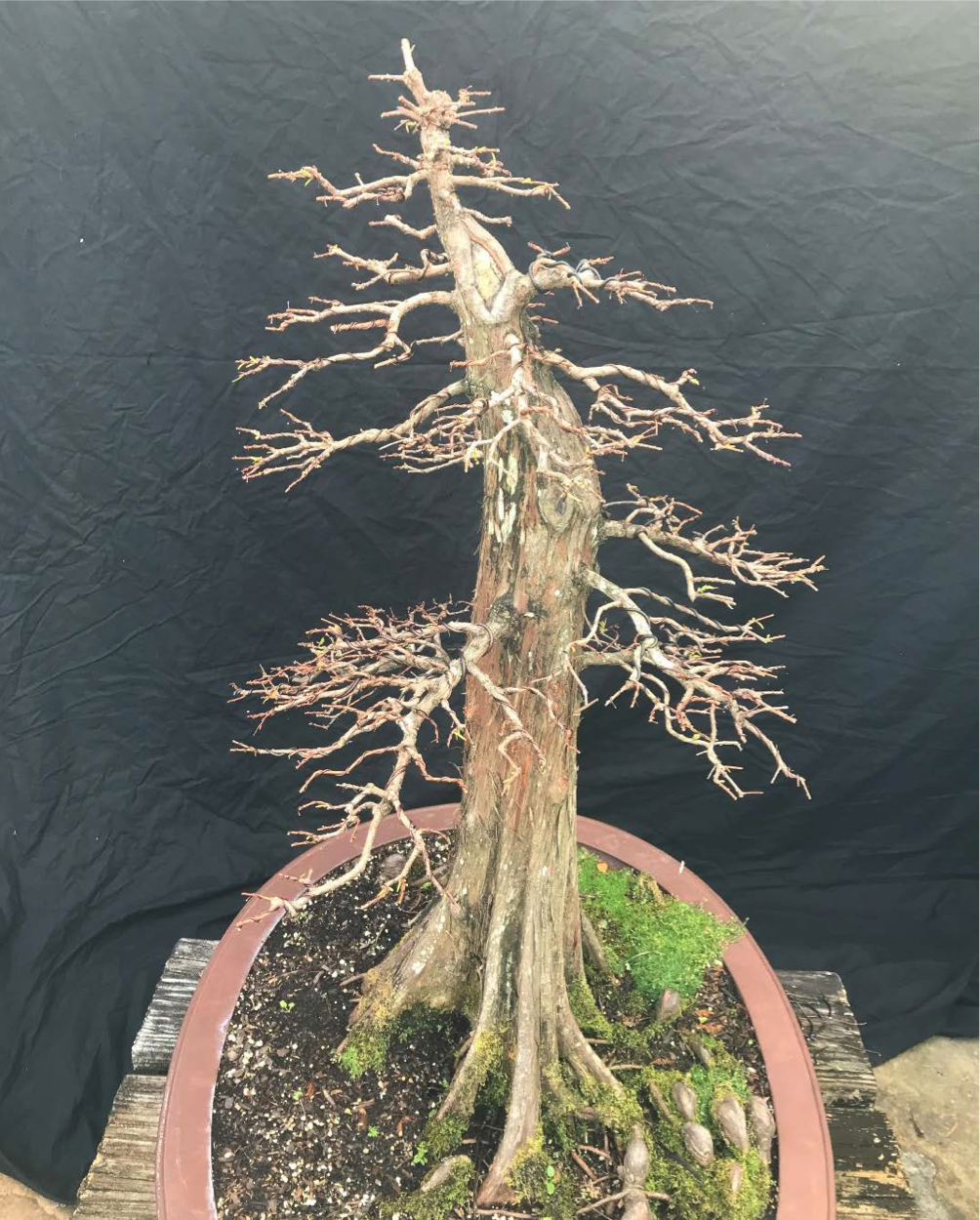
Right side of the tree
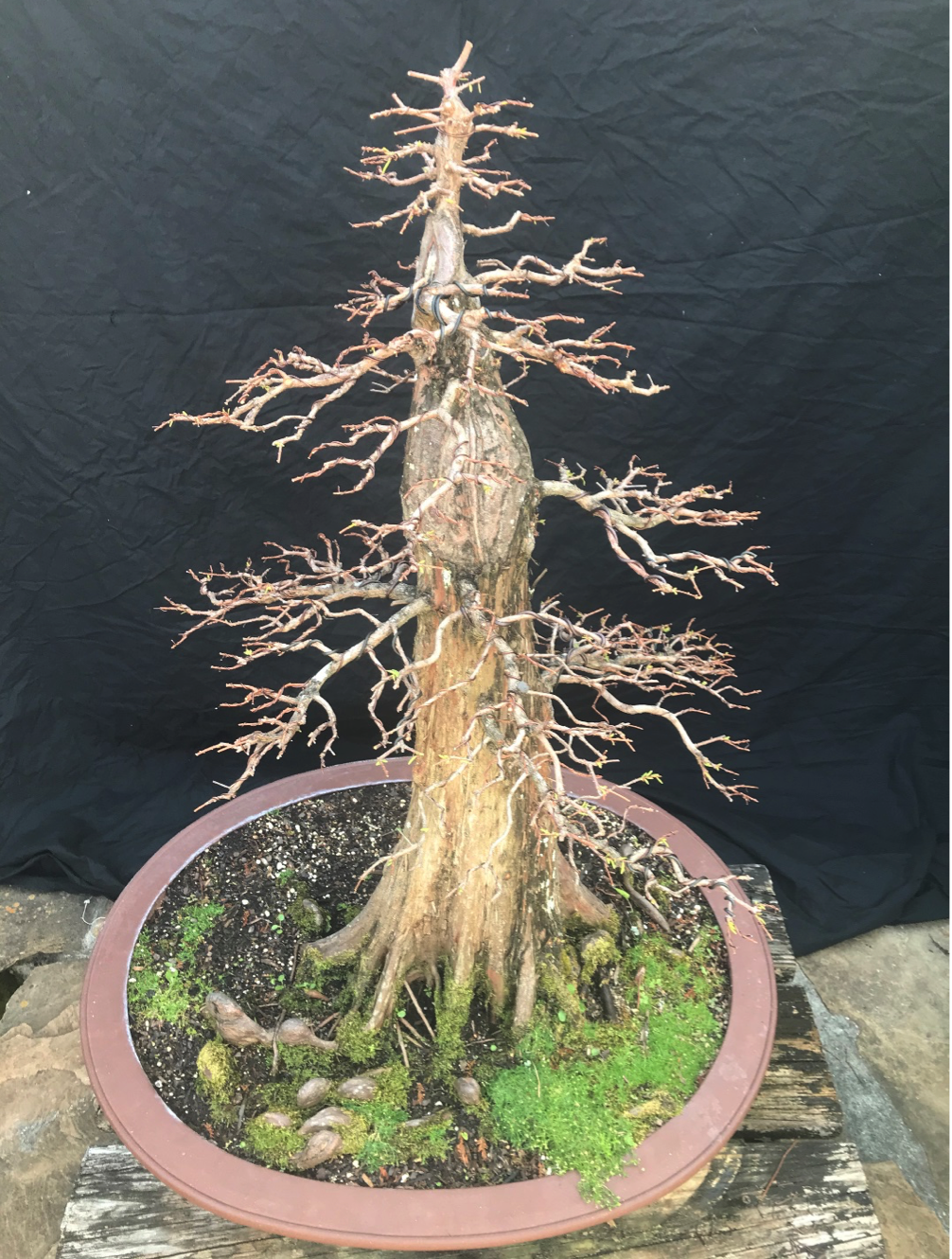
Back side of the tree
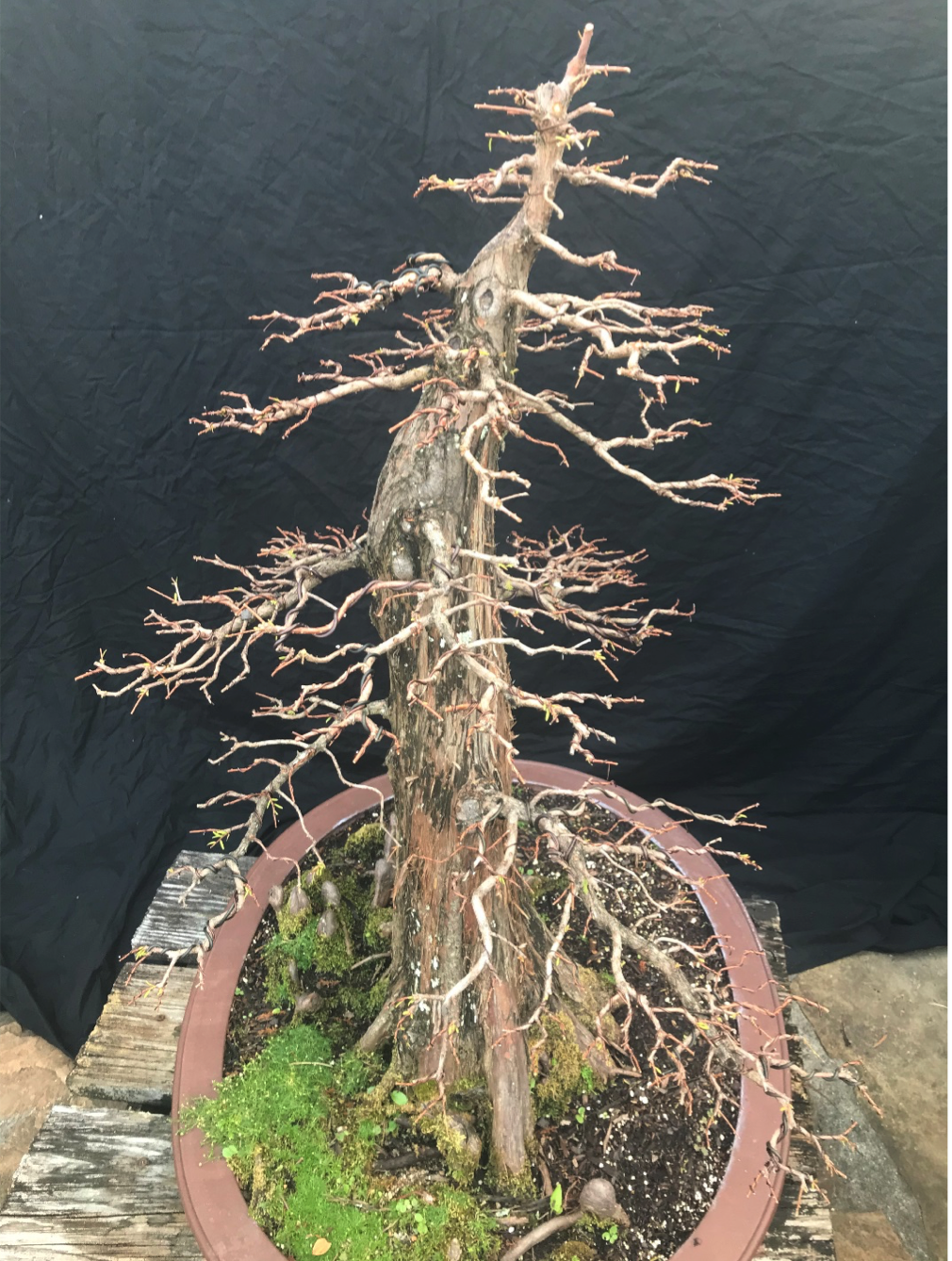
Left side of the tree
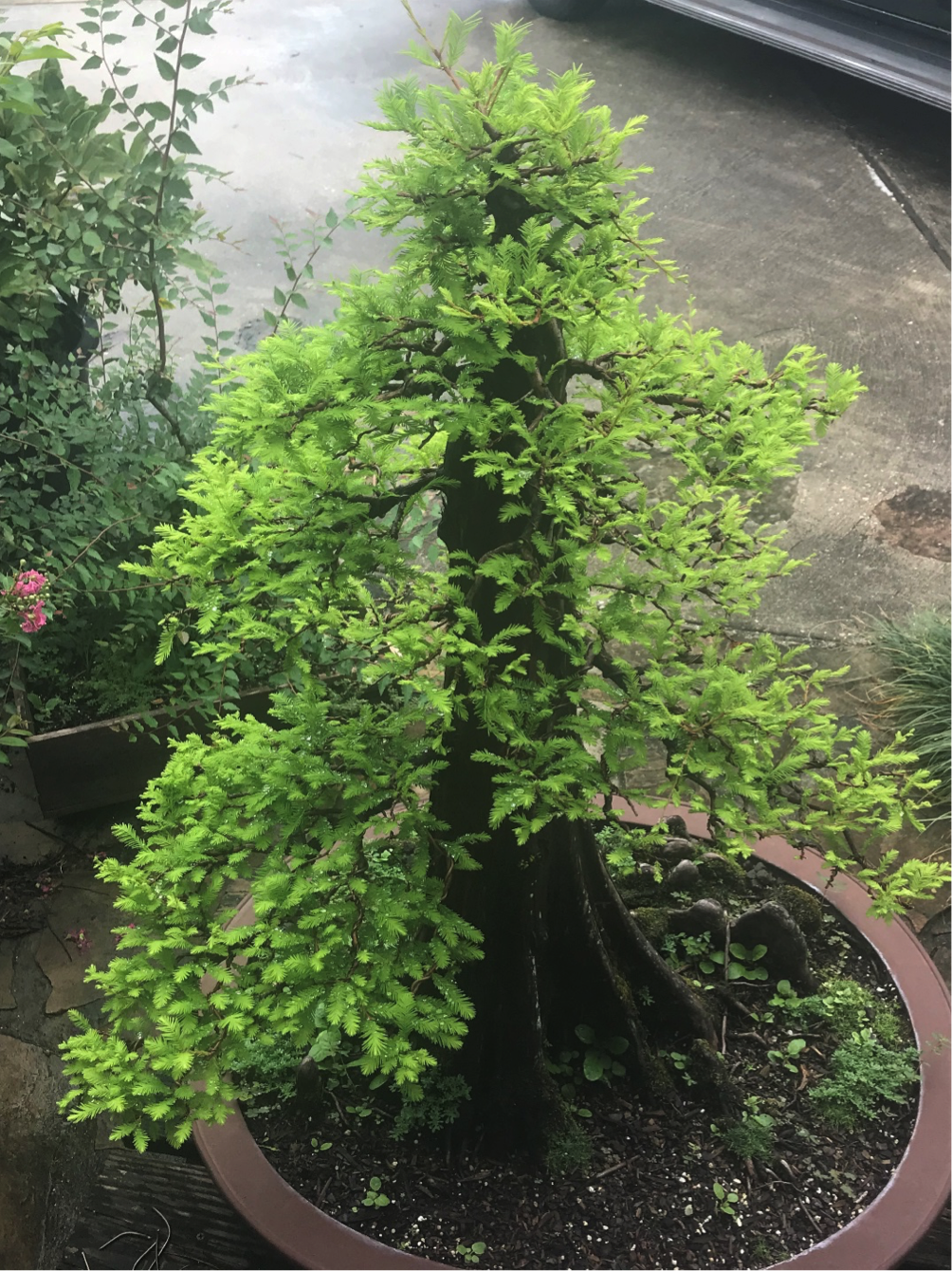
The tree now stands at 37.5 inches above the rim of the pot and 27 inches across at the widest point. The photo below shows the same bald cypress with the new growth after defoliation in July.
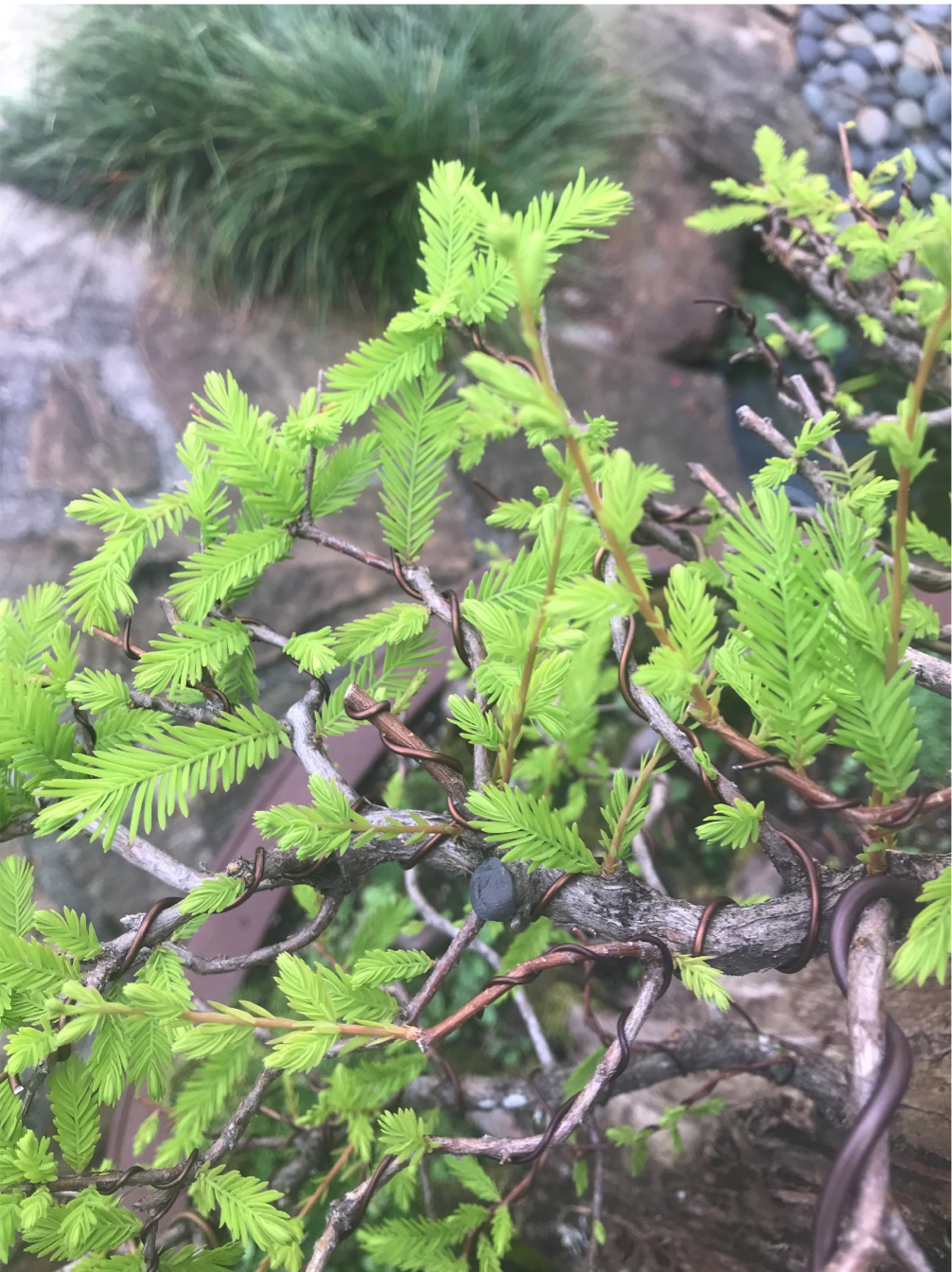
The photo below was taken on August 14th. If you look closely, you will note that, in addition to replacing all the leaves, new shoots have sprouted. However, the new shoots primarily occur at the tip of existing shoots. This does not aid in ramification. You can also see that two new shoots have sprouted in the crotch of other branches. These can be useful if you are trying to develop layers of foliage closer to the trunk. In this case, I already have branches forming layers is both locations, so the new shoots will have to be removed. In fact, if you look at the new shoot in the very center of the photo, you can see that there are already three shoots at that location and the new shoot actually makes four. This is very typical of the way bald cypress back-bud after defoliation and is the reason why you do not use this technique for developing ramification of branches.
I hope you find this article beneficial in the development of your bald cypress bonsai.